
Brass Jewelry Production: Polishing Before Plating
Two of the eight published factory steps are surface work, and both happen before the brass sees the plating tank. Polishing delivers the high-gloss finish and surface art adds the brushed or textured look; the multi-layer gold or rhodium plate then copies whatever the bench left behind. The MOQ for artisan eco-brass is 100 pieces per design.
Key takeaways
- Polishing and surface art are separate published steps, and both precede electroplating.
- Surface art covers brushed and textured finishes, so a design can carry two different looks on one casting.
- An anti-tarnish e-coating is applied over the plating on brass to protect the finished surface.
- The MOQ is 100 pieces per design in artisan eco-brass, and 50 pieces per design in 925 sterling silver.
The two surface steps that sit before the tank
The published step list is short and specific: concept and CAD design and prototyping first, then cutting the sprue, high-gloss polishing and brushed and textured surface art, followed by electroplating to spec, final QC and final delivery. Two of those eight are surface work, and the sequence places them immediately ahead of the coating.
That ordering is the whole argument of this page. Plating does not create a finish, it reproduces one. A casting with tool marks under a bright plate shows tool marks under a bright plate, at greater expense than before.
What polishing actually achieves on brass
Polishing is described as a high-gloss finish, and it follows sprue cutting — the step that detaches the castings from their feed channels and leaves the marks that must be removed. On brass this is the operation that decides whether the plated surface will read as continuous.
It is also the step that cannot be rushed without being visible. A patch buffed unevenly produces a plated surface that reflects unevenly, and no thickness of deposit corrects a shape problem underneath it.
Surface art: the brushed and textured option
Surface art is listed separately from polishing because it does something different. Where polishing aims at gloss, surface art adds the brushed or textured treatment that makes a piece read as matte, satin or hand-worked.
Because it is its own step, a design can carry more than one finish — a polished face with a brushed band, for instance — as long as the masking is specified in the drawing. That specification belongs in the CAD file, not in a conversation at the bench.
Where the plating decision meets the polishing mop
Plating is multi-layer precious metal electroplating in 14K, 18K or 24K gold, plus rhodium, with an anti-tarnish e-coating on brass and silver. Each karat and each colour family reflects the base surface in a slightly different way, which is why the finish choice is best made with the polish level in mind rather than separately.
A high-gloss base under a bright gold plate gives the most mirror-like result. A brushed surface under the same plate reads softer. Neither is better; both need to be named before the run is scheduled.
Using the CAD stage to fix the surface
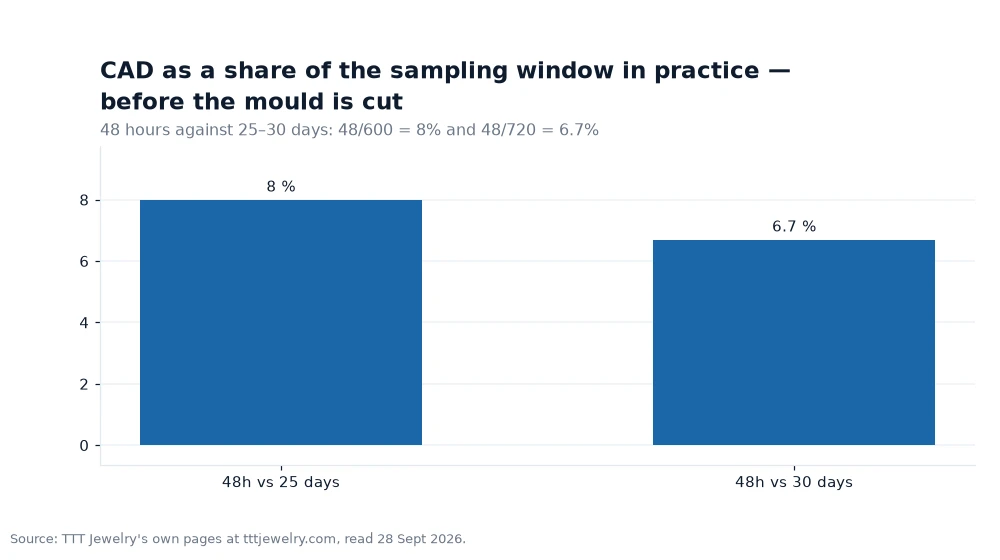
Surface specification is cheap on screen and expensive at the mop. CAD is published at under 48 hours, against 25–30 days for sampling, so the drawing is the place to mark which faces are polished, which are brushed, and where the boundary runs.
For brands commissioning a custom brass jewelry OEM programme, that is the highest-value hour of the project: one annotated drawing removes a whole class of rework that would otherwise appear after the plating tank, when surfaces are already coated.
What happens when plating meets a poor surface
The failure mode is quiet. A plated piece with an uneven base can pass a glance on the bench and be rejected by a customer holding it to the light. The published inspection point is after plating and covers 100% of pieces, so it catches gross defects, not marginal ones.
The practical countermeasure costs nothing extra: ask for a photo of the polished, unplated casting alongside the plated sample at approval. Comparing the two shows exactly what the plating is being asked to hide.
| Operation | Position in the sequence | Consequence if rushed |
|---|---|---|
| Sprue cutting | Step 3 | Feed marks survive into the plated surface |
| Polishing | Step 4 | Uneven gloss under an even plate |
| Surface art | Step 5 | Brushed or textured look reads inconsistently |
| Electroplating | Step 6 | Reproduces whatever the surface already is |
| Final QC | Step 7 | The last point where a bad surface can be held back |
Where oxidation and antique finishes fit
Surface art is not only about brushing. The brass line offers oxidation and antique finishes alongside the gold and rhodium plating layers, which darken recessed detail and leave the raised faces to catch the light. That look depends on the polish level underneath it, so it belongs in the surface specification on the drawing rather than in a separate conversation at the bench.
The same page publishes its own six-step flow — a written requirement confirmation, CAD drawing and precision mould, prototyping with hand polishing, high-standard electroplating plus anti-tarnish, a signed sample confirmation, and 100% manual inspection covering craft, finish, gem setting, size and structure — and describes the material as a premium alloy of copper and zinc that is 100% recyclable.
Worked example: the CAD share against the surface share
Two ratios sit behind a plated brass order. The first is time: 3D CAD is published at under 48 hours inside a 25–30 day sampling window, which is 48 ÷ 600 = 8% of the fast window and 48 ÷ 720 ≈ 6.7% of the slow one. That is the whole screen-work allocation for the project, and it is where the surface specification is written.
The second is process: two of the eight factory steps are surface work, so 2 ÷ 8 = 25% of the sequence is preparing the metal for the coating. A change requested after plating therefore reopens a quarter of the process, in the same order of magnitude as the entire CAD allowance that could have prevented it.
Spread over the published minimum of 100 pieces per design, an extra polishing pass is a bench cost across a hundred units. The screen work that would have avoided it is measured in hours on one file.
Frequently asked questions
Does polishing come before or after plating?
Before. Polishing is a published step ahead of electroplating, and a separate surface art step adds brushed or textured finishes after it.
Can one piece carry two finishes?
Yes, because polishing and surface art are separate operations. Marking which faces take which treatment in the CAD file keeps it consistent across the run.
What is the MOQ for a plated brass design?
100 The published minimums are 100 units in artisan eco-brass, 50 units in 925 sterling silver and 100+ in stainless work, design by design, with each design counted separately.
Specifying the surface before the tank is filled
Send the finish plan with the drawing: which faces are polished, which are brushed, which plating route applies, and whether the piece takes an anti-tarnish e-coating. Brands that compare a plated base metal line against a precious metal one can read the sterling silver production route for contrast, and the wholesale page for how a first quantity is sized.
Where the numbers come from — the 100% recyclable brass claim, followed by the anti-tarnish e-coating on silver, the NDA commitment — is the manufacturer's published pages at tttjewelry.com itself, from my own reading on 28 Sept 2026. The chart's relative scale is mine alone, and nothing else here[1].